
Olive
A wild, noisy stereo voice and effect for drones and textures. Tones that appear and fade by themselves, strings that bow on their own, feedback that howls, springs that fall into chaos, and an input that runs anything you patch into it through the same machinery. Named after the superior olive, the first place in the brain where the left and right ears are compared, and every algorithm is something the hearing path really does.
From chaos to peace
One Olive on its own, no other modules and no effects: just its knobs moving, the way a hand would turn them. All five are on D.
Storm
The Chaos algorithm: a bent spring pushed harder and harder until it falls into chaos, Mask adding dirt, then thrown about.
Swarm
Efferent: a ring of four FM operators bending each other harder until it roars and folds, then backing off.
Unrest
The Beating wall: a clashing cluster of saws that Lock slowly opens into octaves and fifths as the filter opens and closes.
Falling into step
Eight hair bundles beating against each other, until Lock couples them and they sing as one voice.
Peace
The Choir, in tune: sixteen partials rising and falling slowly by themselves, with a soft breath.
How these were made
Rendered by Olive's own engine, the same code that runs in the Rack and will run on the hardware, with nothing added afterwards. The patches below put Olive together with other modules.
Dark, eerie, sinister
Five more from one Olive on its own, no effects, for the night. Low places, Lock left loose so things grind against each other, and a trigger knocking now and then.
Undertow
Six strings bowed on a low D, out of tune with each other, groaning and grinding as the dirt rises.
Breathing
Eight emissions low in the dark, each a rasp of breath, swelling in and out and moving around your head. Best on headphones.
Dead station
Ghost tones that nobody played, drifting like a radio caught between stations, folding and crushing as they go.
Something knocks
A feedback loop creeping toward a howl, out of tune, and now and then something knocks on it.
Something below
The Chaos spring on a low D, barely pushed, lurching without warning in the sub, until it finally rises.
Turn it up
These sit low and quiet on purpose. Headphones or a good pair of speakers bring out the sub and the movement between left and right.
Ten patches
The first five use Olive in different ways, from ambient to techno to an effect. The last five are pure drones and textures.
Inner Ear
Three Olives singing by themselves in D: a choir, emissions swelling in and out on a slow tide, and bowed strings underneath.
Funk
118 BPM in A minor: Olive's Beating wall as the bass, played through Place and its VCA, while the drums shout into a second Olive's feedback howl, ducked by the kick.
Basilar Bells
Plucked strings tuned by a sequencer: every pluck rings octaves and fifths, like a harp of bells, over a drone of locked hair bundles.
Chaos Engine
Two Olives are the whole kit: an FM ring is the kick and bass, a chaotic spring makes the hats, so no two ticks are alike.
Hearing Aid
Olive as an effect: Corti plays an arpeggio into Olive's feedback loop, which rings with every note and now and then sings on by itself.
Vortex
A folded FM ring thrown about by a random LFO, pouring into a loop that howls back around it.
Dust and Time
Glass-like emissions and a choir drifting in and out of a crushed sample rate: from glass to dust and back.
Alien Radio
Ghost tones whose spacing steps like a dial being turned, and voices tuning in and out of each other, into a long echo.
Iron Lung
A bent spring groaning under a slow push on a low D, waking six bowed strings that sing back over it.
Cloud Chamber
A wide wall of beating saws, its filter opening and closing over forty seconds, caught by hair cells that ring.
Drones the ear makes by itself
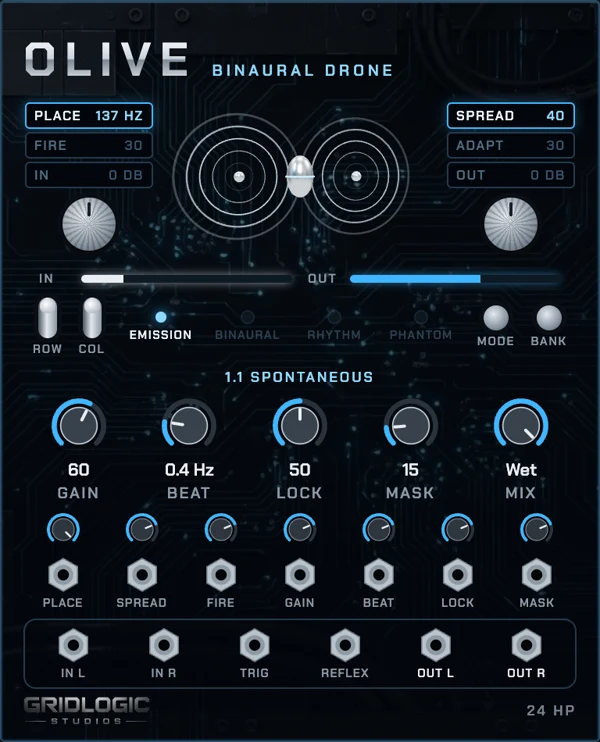
A healthy ear gives off faint tones of its own. The first bank is nine ways a hearing system can sing without being asked. Two three-way switches pick one of the nine.
Spontaneous
Eight hair-cell oscillators along the cochlea. Past halfway on Gain they sing on their own, tones appearing and fading like real ear emissions.
Hair bundle
Eight neighbouring hair bundles pulling on each other. Lock couples them from shimmering beats into one voice.
Distortion product
Two tones bent by the cochlea, and the ear answers with tones nobody played, exactly what audiologists measure.
Efferent
A ring of four sine operators each bending the next, from a hollow tone to a roaring, chaotic swarm.
Larsen
The howl of a hearing aid hearing itself: four echoes feeding each other. The input shouts into the loop.
Basilar
Six strings along the basilar membrane, bowed by nerve noise. Past halfway they sustain by themselves; a trigger plucks them.
Beating wall
Seven saws beating against each other through a filter that screams. Lock opens the wall into octaves and fifths.
Chaos
A bent spring pushed back and forth until it can't decide which way to fall. Lock steadies it back into a tone.
Choir
Sixteen partials rising and falling on their own and breathing. Spread stretches them into bells and glass.
Three more banks
- Binaural: left against right. Beating between the ears, phantom pitches between the speakers, sound that moves around the room.
- Rhythm: the midbrain locks onto rhythm. A trigger or LFO fires bursts like nerve spikes, from metallic hits to stutters.
- Phantom: the brain filling in what it expects to hear. Ringing, missing fundamentals, endlessly rising tones, spectral freeze, and a cochlear vocoder for the input.
One meaning everywhere
- Place is the pitch, from 25 Hz to 3.2 kHz, and tracks 1 V/oct. Spread is how wide the sound is.
- Fire is how hard the nerve fires: noise and excitation. Adapt is how fast the sound wanders by itself.
- Gain is the ear's own amplifier: past halfway the sound sings by itself, then screams.
- Beat pulls the right ear away from the left. Lock goes from free and clashing, through just intervals, to only octaves, fifths and fourths, so it sits in any key.
- Mask is dirt: saturation, then folding, then a crushed sample rate. Mix blends the input with Olive.
24 HP, no screen
Everything is on the panel: lit windows show what the two encoders are turning, and every knob that moves the sound has its own CV jack.
| Part | What it does |
|---|---|
| 2 encoders | Place and Spread, Fire and Adapt, or the In and Out volumes, picked with Mode and shown in lit windows |
| Row, Col, Bank | Two three-way switches pick one of nine algorithms; Bank steps through the four banks (36 algorithms) |
| 5 knobs | Gain, Beat, Lock, Mask, Mix |
| 7 attenuverters | How much, and which way, each CV jack moves its control |
| Inputs | Audio in L and R, Trig (strikes, plucks, kicks), Reflex (a VCA that overdrives above 5 V), and CV for Place (1 V/oct), Spread, Fire, Gain, Beat, Lock and Mask |
| Outputs | Out L and R |
| Mode + Bank | Press both together for a new random sound in the same algorithm |