
Corti
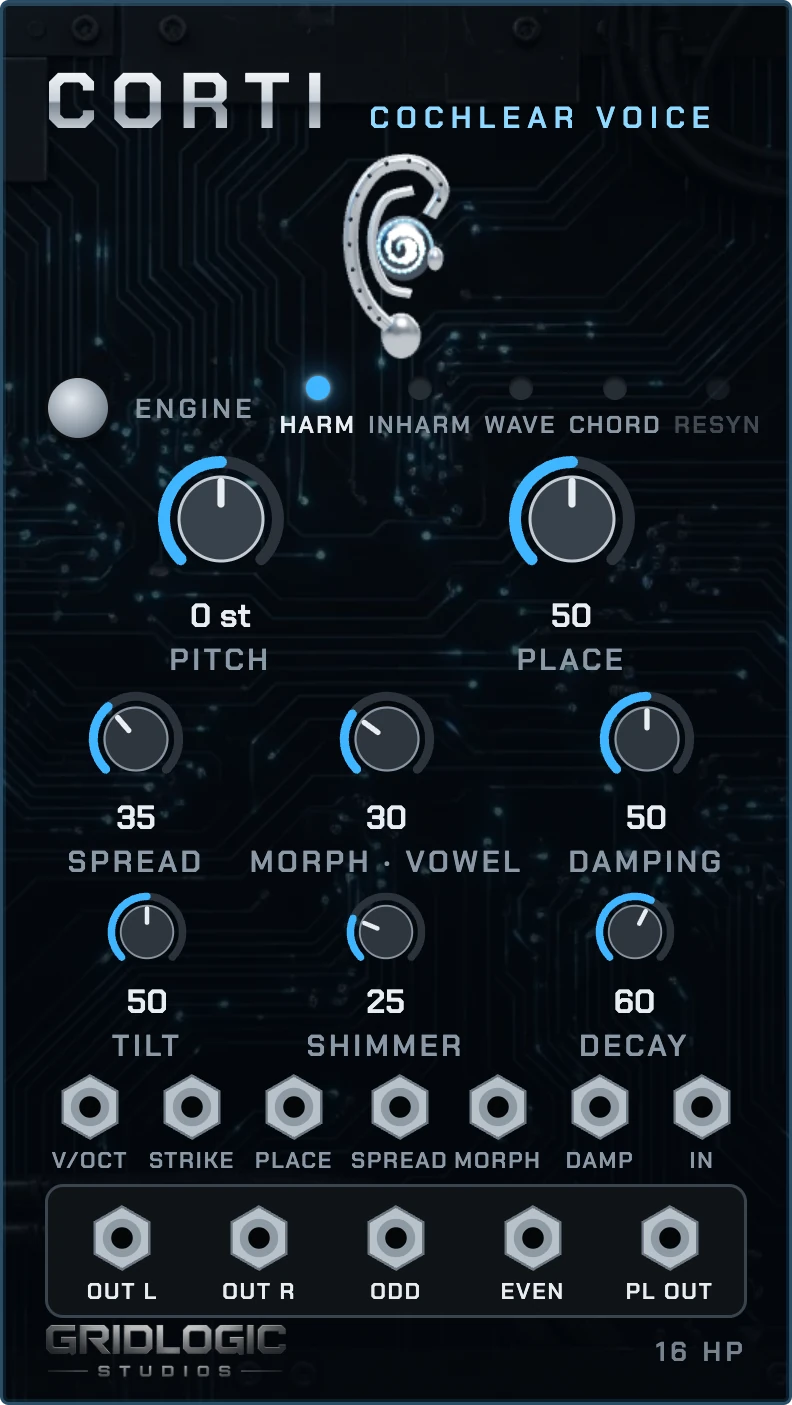
A digital voice built the way the ear hears. Named after the organ of Corti, the part of your cochlea that turns vibration into nerve signals. Instead of starting from waveforms, Corti starts from places along the cochlea: choose where the ear is excited and how widely, and 64 tuned partials build the sound that would excite it that way.
First sounds
Place sweep
One held note while the energy travels along the cochlea, from deep to bright.
Vowels
Morph walks a held note through A, E, I, O and U.
Struck melody
Plucked notes; high partials die away faster than low ones (Damping).
Shimmer pad
Wide, slowly drifting partials.
Strings to plates
Struck notes as Morph moves from a stiff string, through bell, to metal plate.
Travelling wave
Struck notes; each strike sends a wave down the cochlea, bright first, then settling. Morph speeds the wave up as it goes, from a slow glide to a snap.
Chords
One note in, eight chords out: Morph steps through octave, fifth, major, minor, sus4, maj7, min7 and add9.
Drums into the In jack
A simple drum loop played into Corti's audio input: no notes are struck, the drums ring Corti's resonances, tuned to C then G.
What you're seeing
Below: the place sweep as a spectrogram. Each line is a partial; the bright band is where the ear is excited.

Five ways to excite the ear
Harmonic
Partials lock to the note. Place and Spread choose where on the cochlea the energy sits; Morph adds vowel formants.
Inharmonic
Morph stretches the partials from a stiff string through bell to metal plate, each mode nudged off its ideal pitch like real metal.
Travelling wave
Each strike launches a wave at the base of the cochlea that runs down to Place, like the real wave inside your ear. Every place it passes keeps ringing, so the sound sweeps from bright to settled. Morph sets the speed.
Chord
One note in, a chord out: octave, fifth, major, minor, sus4, maj7, min7 or add9, chosen with Morph. Each place on the cochlea takes the nearest harmonic of any chord tone.
Ear resynthesis
A 64-band cochlear filter bank listens to the audio input and re-sings it at the played pitch. Freeze lives here: hold one moment of the input as a sustained chord.
Cochlear sampling
Every harmonic down low, selected ones up high, spread along the ear's own frequency map: the full range of hearing at any pitch.
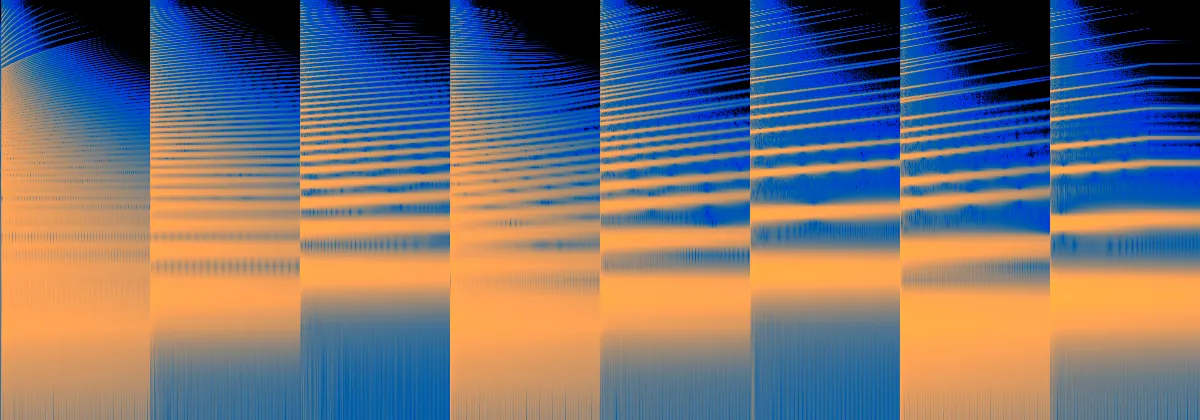
Strings to plates: each strike's partials spread further from harmonic spacing as Morph turns.
How it plays in your rack
The first release runs on Electrosmith's patch.Init(). The toggle switch is a shift layer, so four knobs give eight controls.
| Control | Switch down (Play) | Switch up (Shape) |
|---|---|---|
| Knob 1 | Pitch | Damping |
| Knob 2 | Place | Tilt |
| Knob 3 | Morph | Shimmer |
| Knob 4 | Spread | Decay |
| patch.Init jack | Corti jack | Job |
|---|---|---|
| CV 1 to 4 | V/OCT, PLACE, MORPH, SPREAD | Pitch (1 V per octave), then voltage control of Place, Morph and Spread |
| Gate 1 / Gate 2 | STRIKE / none yet | Strike / Freeze (with Ear resynthesis, in the free update) |
| Audio in L / R | IN | Listening input (resynthesis) / Exciter: any audio strikes the partials |
| Audio out L / R | OUT L / OUT R | Stereo, partials spread across the field |
| CV out | PL OUT | Place: where the sound sits on the cochlea |
| Gate outs | none yet | End of ring / Onset: fires when it hears a new sound start on the input |