
Anvil
A complete voice in one module. Two oscillators per voice, each drawn from five different kinds of synthesis, a resonant filter that morphs from low-pass to notch, two envelopes, three LFOs, an eight-slot modulation matrix and a stereo tape delay. Play it as one voice, a detuned unison stack, a chord from one note, two independent voices, or four-voice poly. Named after the anvil, the small bone of the middle ear that passes sound on to Corti's cochlea.
First sounds
One note, five engines
The same note through Analog, Wavetable, FM, Cochlear and String in turn, Timbre sweeping on each.
Evolving pad
Poly 4: a vowel wavetable against Corti-style cochlear partials, slow LFOs moving both, into the tape delay.
Unison lead
A detuned stack with a saw an octave below, a touch of drive and glide.
Acid
Anvil's Acid filter, modelled on the TB-303's diode ladder: one saw, slides and building accents, resonance and cutoff swept up together and back down.
Plucked strings
Poly 4: the String engine with an FM bell layer, through the ping-pong delay.
Coming to the Rack
Anvil is coming to the free Gridlogic Rack, with example patches from a soft ambient drift to peak-time techno.
Open the Rack →Five engines, two at a time
Each voice has two oscillators, and each can be any of the five. Mix them, let B frequency-modulate A, add noise. Every engine has the same two controls, Timbre and Shape, which mean something different in each.
Analog
Sine, triangle, saw and square in one sweep, with hard sync on Timbre. Band-limited, so it stays clean up high.
Wavetable
Eight tables, sixteen frames each: sine to saw, hollow square, vowels, glass, drawbar organ, sync sweep, wavefolder and comb.
FM
Two operators. Shape picks the ratio, from 1:0.5 to 1:7; Timbre sets the brightness, from soft to bell and metal.
Cochlear
Corti's idea in miniature: sixteen harmonics weighted by where they land on the ear's frequency map. Timbre is the place, Shape the spread.
String
A plucked string: a burst of noise ringing in a tuned loop. Timbre sets the brightness, Shape how long it rings.
Noise and cross-FM
White noise in the mix for breath and wind, and oscillator B frequency-modulating A for growl and clang.
Filter, envelopes, matrix
- Filter: three characters. Clean morphs continuously from low-pass through band-pass and high-pass to notch, 12 or 24 dB; Ladder is a warm four-pole; Acid is modelled on the TB-303's diode ladder. Resonance, key tracking and drive in front.
- Envelopes: ENV 1 shapes the volume, ENV 2 is free (it opens the filter by default and has its own output jack).
- LFOs: three, each sine, triangle, saw, square, sample-and-hold or smooth random; LFO 1 can follow a clock.
- Matrix: eight slots connecting any source (LFOs, envelopes, the four CV jacks, random, note) to any destination, from pitch and filter to pan and delay time.
Stereo tape delay
- Up to four seconds, or synced to a clock from a sixteenth to a full bar.
- Tape mode: wow, flutter and saturation in the repeats.
- Ping-pong, a tone control in the feedback, and Freeze, which holds whatever is in the delay as a loop.
- An audio input runs through the filter and the delay, so Anvil also works as an effect for the rest of your rack.
One module, five ways to play it
| Mode | Voices | Played by |
|---|---|---|
| Mono | 1 | V/OCT 1 and GATE 1, with glide |
| Unison | Up to 4, stacked and detuned | V/OCT 1 and GATE 1 |
| Chord | 4 from one note (major, minor, sus4, maj7, min7, dom7, add9, power) | V/OCT 1 and GATE 1 |
| Duo | 2, independent | V/OCT 1 + GATE 1 and V/OCT 2 + GATE 2 |
| Poly 4 | 4 | MIDI, from a sequencer or keyboard |
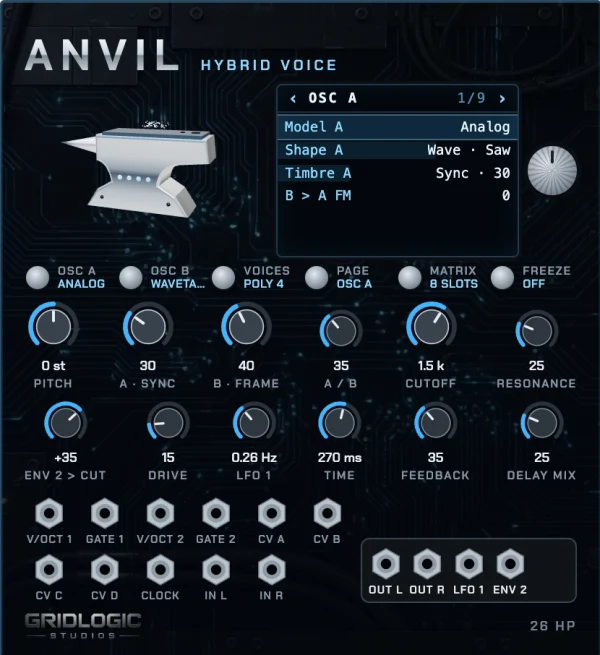
26 HP, built for hands
A screen and encoder reach everything; the twelve knobs are the controls you reach for while playing.
| Part | What it does |
|---|---|
| 12 knobs | Pitch, Timbre A, Timbre B, A/B mix, Cutoff, Resonance, Env 2 to cutoff, Drive, LFO 1 rate, Delay time, Feedback, Delay mix |
| Screen + encoder | Nine pages: Osc A, Osc B, Filter, Env 1, Env 2, LFOs, Matrix, Voices, Delay |
| 6 buttons | Osc A engine, Osc B engine, Voice mode, Page, Matrix, Freeze |
| Inputs | V/OCT 1, GATE 1, V/OCT 2, GATE 2, CV A to D (assignable), Clock, MIDI (TRS), Audio in L and R |
| Outputs | Out L and R, LFO 1, Env 2 |